
Foil Slalom Racing
Foil Performance
Performance Profile
Technical Specifications
Program Profile
-
Entry 0/10
-
Wave 0/10
-
Freeride 6/10
-
Freestyle 0/10
-
Race 10/10
-
Foil 10/10
Performance Metrics
* Trim and conditions dependent
Construction Materials
Sails Specifications
| Size | Luff | Boom | Head | Extension | Battens | Cambers | Weight | Rec. Mast |
|---|---|---|---|---|---|---|---|---|
| 4.3 | 392 cm | 150 / 152 cm | Fixed | 22 cm | 6 | 3 | 4.37 kg | Team Edition RDM 370 |
| 5.0 | 430 cm | 162 / 164 cm | Fixed | 30 cm | 7 | 4 | 5.21 kg | Team Edition RDM 400 |
| 6.0 | 464 cm | 172 / 176 cm | Fixed | 34 cm | 7 | 4 | 5.47 kg | Team Edition SDM 430 |
| 7.0 | 496 cm | 182 / 186 cm | Fixed | 36 cm | 7 | 4 | 5.83 kg | Team Edition SDM 460 |
| 8.0 | 524 cm | 196 / 200 cm | Fixed | 34 cm | 7 | 4 | 6.2 kg | Team Edition SDM 490 |
Could not load this selection. Please try again.
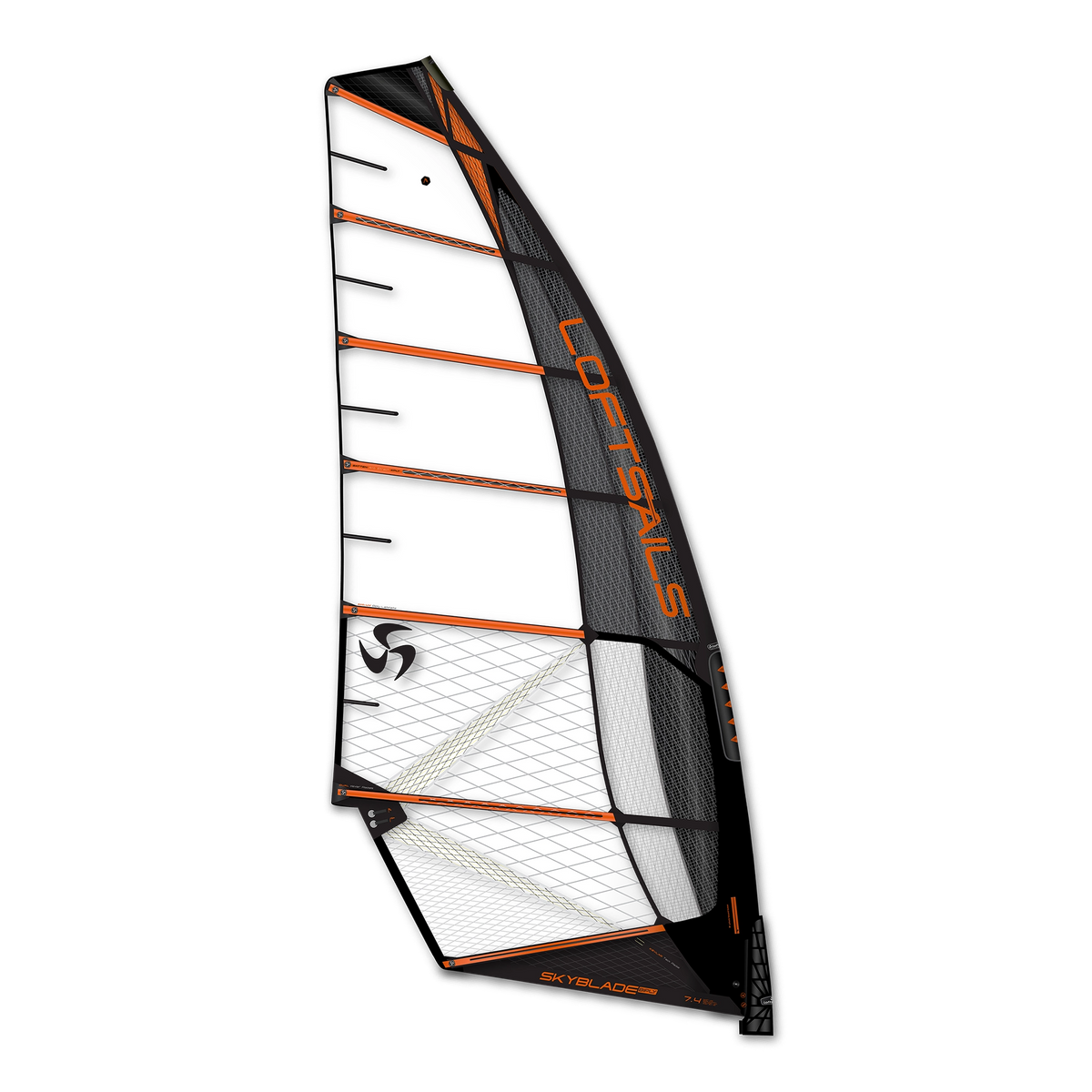
Skyblade 7.0 White 2027
Description
Skyblade 2027
Dedicated foil racing, without compromise.
The Skyblade is Loftsails' pure foil slalom sail — developed specifically for competitive hydrofoil racing and designed to perform when flying at full speed for entire heats. This is not a crossover. It's a dedicated racing tool for foiling at the limit.
Efficiency You Feel in Flight
Slim, efficient profiles and a flat entry create a low-drag working shape optimized for the close angles of attack characteristic of high-performance foiling. The sail accelerates decisively onto the foil and settles into a clean, stable profile that allows you to focus on trim, angle, and tactics rather than managing the rig.
Stability Refined for Foil Racing
Foil racing demands a very specific balance. A slightly reduced aspect ratio makes the sail more stable and less sheeting-sensitive — less likely to be oversheeted, with more homogenous handling through variations in wind strength. A narrower head with slightly increased head height improves high-wind stability, keeping the rig composed when speed and apparent wind build.
Slightly deeper clew cut-outs promote greater lower leech twist, making speed easier to find and hold across the entire wind range. The 4.3 m² now shares this clew cut-out geometry with the larger sizes — improving upper-end handling critical for this small, high-load size.
Batten and Cam Architecture for Speed
Carefully tuned carbon battens create a light, stiff framework that holds a clean, efficient profile with minimal drag. The sail reacts instantly to trim changes while maintaining its shape at speed.
TekCam 3 cams — lightweight and precisely engineered — support higher batten angles and deliver smooth, reliable rotation. Consistent cam behavior is essential in foil racing, where hesitation through gybes or transitions costs speed and rhythm.
Loftsails' Signature Mast Pocket
The mast panel and mast pocket extend under the tack roller, equalizing downhaul tension across three layers for rotation ease, clean and taut sleeve sides, and long-term longevity. A double-layer, stretch-resistant zone combines 2 mil quad-axial X-Ply with IYU250 woven material, running from head to tack. A 50 mm triple-sewn mast sleeve seam resists wear through repeated rigging, tuning, and racing.
Load Control Where It Matters
Dual Kevlar laminate clew radials manage load transfer into the sail body, supporting consistent forward drive and profile stability under sustained sheeting and outhaul tension. Metallic Cam Interfaces at all cam contact points prevent material wear and ensure consistent cam behavior under high loads. X-Ply laminates reinforce the window, leech, and foot. 5 mil X-Ply foot panels add durability in critical wear zones.
Functional Minimalism
By reducing excess marker cloth and scrim, overall weight is kept in check and the sail's center of mass lowered. This improves reactivity and balance in flight while preserving durability where it matters most. Nothing decorative. Everything designed to support speed and control.
Skyblade, Defined
For competitive sailors who demand efficiency, balance, and consistency at speed — and who expect their equipment to perform the same way from the first start to the final reach. When foil racing becomes about precision rather than survival, Skyblade is designed to give nothing away.
Frequently asked questions
The most significant change across the Skyblade range is a slightly reduced aspect ratio — making the sail more stable, less sheeting-sensitive, and more consistent to handle as wind strength varies. Head width is reduced and head height slightly increased, improving composure when speed and apparent wind build in stronger conditions.
Slightly deeper clew cut-outs have been introduced across the range, promoting greater lower leech twist and making speed easier to access and maintain throughout the wind range. The 4.3 m² gains a clew cut-out for the first time, bringing its upper-end handling in line with the larger sizes — a meaningful improvement for this small, high-load design.
The Skyblade is designed for competitive foil racing in medium to strong wind conditions.
It performs best when sailors are flying fully powered for extended periods, where stability, efficiency, and control in flight matter more than versatility or ease. The sail is tuned for low-drag hydrofoils and racecourses where speed, angles, and consistency decide results.
Skyblade is not intended for casual foiling or freeride use. It is built for racing environments where trim is precise and performance must remain stable throughout an entire heat.
The Skyblade is intended for experienced and competitive foil sailors.
It suits riders who are comfortable sailing powered on the foil, tuning downhaul and outhaul precisely, and adjusting their setup to match board, foil, and conditions. The sail rewards accurate rigging and an understanding of how small trim changes affect lift, balance, and speed.
Sailors new to foiling or looking for a more forgiving, crossover foil sail will generally be better served by freeride-oriented designs.
We recommended the Team Edition SDM 460
Both sails are race-derived, but they are designed for different disciplines.
Skyblade is a dedicated foil racing sail, optimized for low-drag hydrofoils and sustained flight. Its balance, aspect ratio, and structure are tuned to remain stable and efficient when flying fully powered, with minimal vertical movement and maximum control in the air.
Racingblade is a fin slalom race sail, designed to work with single-fin boards and water contact. It focuses on acceleration, speed through chop, and maintaining efficiency under sustained fin-driven loads.
In short, Skyblade is built for racing above the water, while Racingblade is built for racing on it.
The Skyblade is designed to be used with dedicated foil race boards and low-drag race foils.
It pairs naturally with modern foil slalom boards and high-performance racing foils, where its locked-in profile and stable center of effort can be fully exploited. The sail supports consistent lift, efficient angles, and controlled speed during long powered reaches and technical race maneuvers.
For freeride foil boards, a more forgiving sail design will generally offer better usability.
Like all Loftsails designs, the Skyblade is highly trim-sensitive — and that sensitivity is what gives it a wide usable wind range.
Small changes in downhaul and outhaul produce clear, immediate differences in balance, lift, and control. This sensitivity allows experienced racers to fine-tune the sail precisely to the conditions, board, and foil they are using.
That trim sensitivity is intentional. It gives competitive sailors the tools to adapt heat by heat — without changing equipment, and without the sail changing character.
